
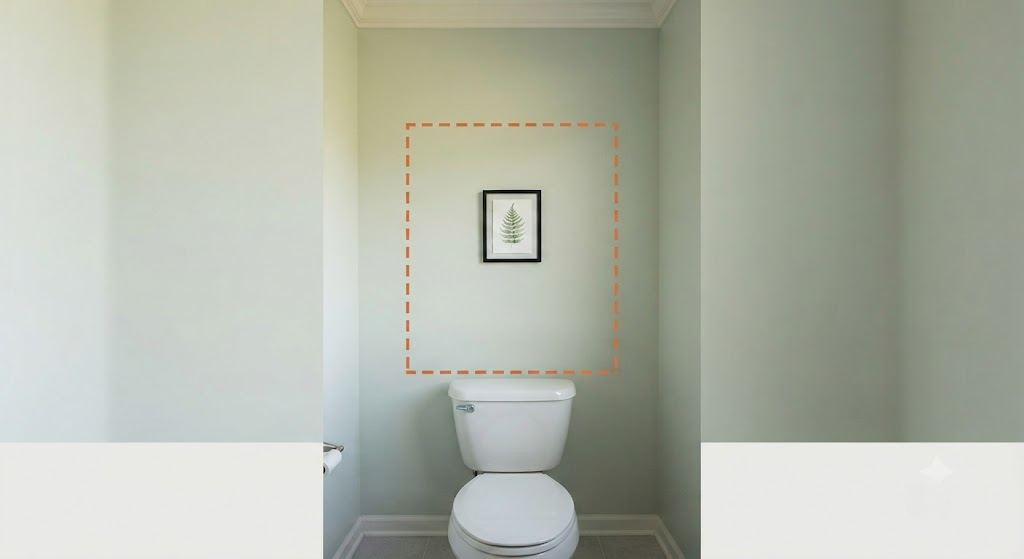
Every small bathroom has one wall that almost nobody uses well. It's above the toilet. In a standard 5×7 layout, that wall measures roughly 30 inches wide by 40 inches of usable vertical height — about 8 square feet of prime real estate, sitting completely empty in most homes.
I've seen what usually ends up there: a small framed print hung too high, a single floating shelf with a candle that's never been lit, or worse, one of those sagging three-tier wire racks that came with the apartment. None of them solve the actual problem. The problem is that small bathrooms run out of closed storage fast, and open shelving above a toilet puts your spare toilet paper and cleaning supplies on display for every guest who walks in.
What Actually Works Above a Toilet
The dead wall above the toilet has two things going for it: it's centrally located, and it's deep enough to accommodate shallow storage without interfering with the fixture below. Code requires 15 inches of clearance from the toilet centerline to any side obstruction, but you typically have a full 30 inches of width between those lines — exactly the width of a standard wall cabinet.
The Over-Toilet Cabinet That Doesn't Look Like One
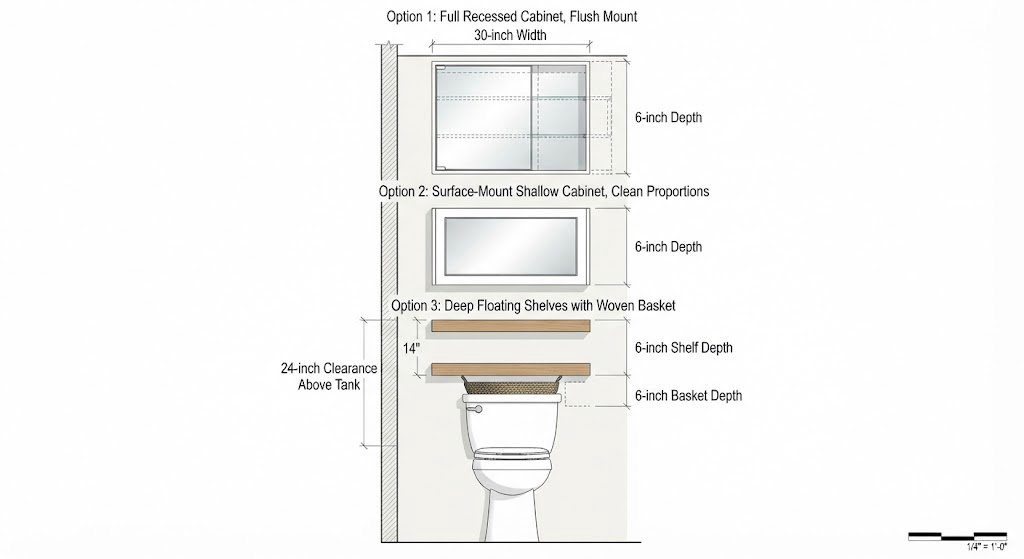
I spec a recessed or surface-mount cabinet that spans 24 to 30 inches wide and 30 to 36 inches tall, mounted with its bottom edge at least 24 inches above the toilet tank. That gives you roughly 5 to 7 cubic feet of storage behind closed doors — enough for spare towels, toilet paper, cleaning supplies, and the extra hand soap bottles you bought in bulk.
The key is depth. Anything deeper than 8 inches starts to loom over the toilet and crowd the user. I stay at 6 to 7 inches — deep enough for folded towels and standard toiletry bottles, shallow enough to read as part of the wall rather than a piece of furniture hanging in midair.
Three Ways to Claim That Wall
Recess It
If the wall behind the toilet is an interior partition and you have access to the stud cavity, recess a shallow cabinet between the studs. A 30-inch-wide recessed cabinet that's 6 inches deep and 36 inches tall gives you almost 5 cubic feet of flush, invisible storage. The face can be painted to match the wall or finished with a simple shaker panel that looks like architecture, not cabinetry.
Hang a Single, Intentional Unit
When cutting into the wall isn't an option — rentals, concrete, plumbing vents — I use a single surface-mount cabinet sized exactly to the wall width. IKEA's GODMORGON high cabinet is 12 inches deep, which is too deep. But West Elm and CB2 both make 6-to-8-inch-deep wall cabinets that work. Mount it so the top aligns with the top of any door trim in the room. That visual alignment is what makes it feel built-in, not bolted-on.
Build Up, Not Out
If even a shallow cabinet feels like too much mass, install two floating shelves with a lip — 6 inches deep, mounted 12 and 24 inches above the toilet tank. The lower shelf holds a small closed basket for personal items. The upper shelf holds a single stack of clean towels. That's it. No tiny plants, no apothecary jars, no visual clutter. Storage that breathes.
What I Wouldn't Do
Don't install an over-toilet étagère with open legs that straddle the tank. It locks you into that specific toilet height forever, it's a pain to clean around, and it announces to the room that you ran out of ideas. Don't hang a cabinet so low that you can't lift the toilet tank lid for repairs. And don't fill whatever you install with decor. This is working storage. Treat it that way.