
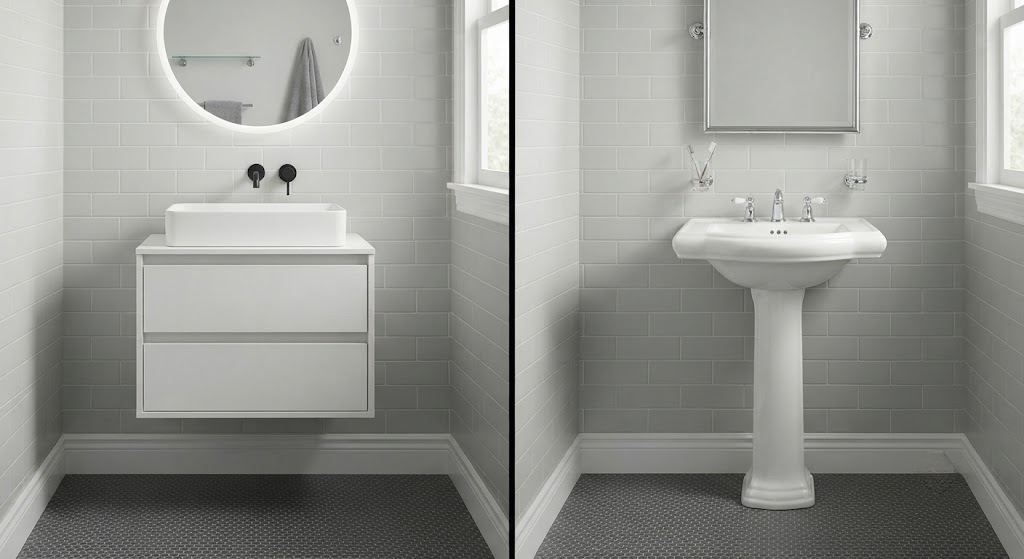
The vanity-versus-pedestal debate isn't about style. It's about what you need to store within arm's reach of the sink — and what you're willing to sacrifice to get it.
I see the same mistake in both directions: a floating vanity crammed into a bathroom so narrow that the drawer barely opens, or a pedestal sink in a family bathroom where three people are stacking toiletries on the floor because there's nowhere else to put them. The fixture is never the problem. The mismatch between the fixture and the storage reality is.
What a Floating Vanity Actually Stores
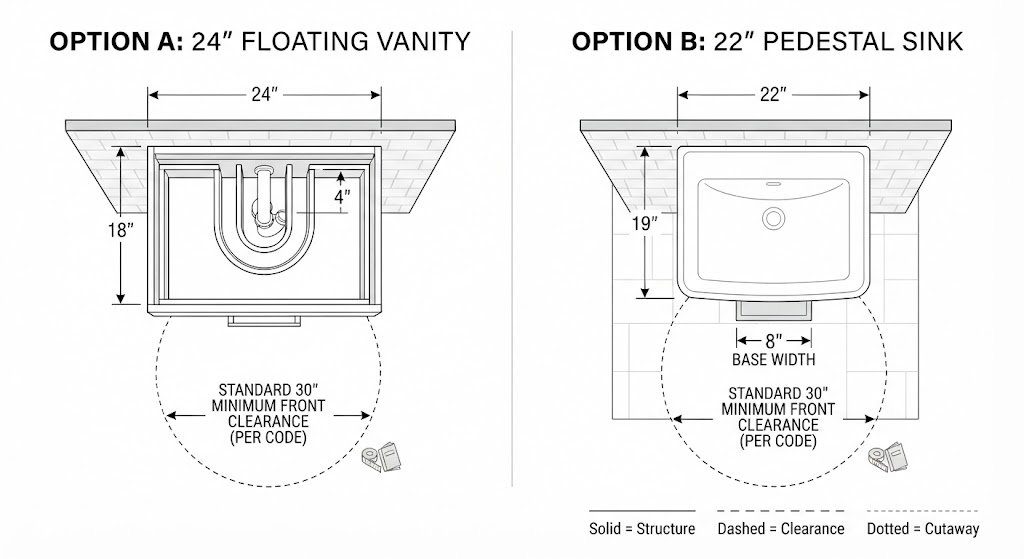
A standard 24-inch floating vanity with a single drawer gives you about 18 inches of usable drawer width, 4 inches of interior depth, and roughly 16 inches of front-to-back drawer travel. That's 1,152 cubic inches — enough for a hair dryer, a flat iron, toothpaste, daily skincare, and a small divided organizer for makeup or shaving supplies. Not glamorous math, but real math.
The Drawer-Depth Trap
Most off-the-shelf floating vanities use a false drawer front above the sink basin, so you lose the top drawer entirely. What looks like a two-drawer vanity is often one real drawer and one decorative panel hiding the plumbing. I spec vanities with a U-shaped drawer that wraps around the trap — Signature Hardware and Nameeks both make them — or I go custom. The extra cost for a functional top drawer is usually $200 to $400. Over 10 years of daily use, that's money well spent.
If you're buying a vanity online, search the installation photos, not the product shots. If the drawer interior isn't shown, assume it's shallow.
When a Pedestal Sink Wins
A pedestal sink has a footprint of roughly 22 inches wide and 18 inches deep, with the column tapering to something closer to 8 inches at the base. That slender profile buys you floor space no vanity can match.
In a powder room that's 4 feet wide, a pedestal sink is often the only fixture that lets you walk past the sink to the toilet without turning sideways. In a bathroom that already has a linen closet or a recessed wall cabinet handling the storage, a pedestal sink visually opens the room — the floor tile runs uninterrupted wall to wall, and the room reads as larger than it is.
The Rental Pedestal Play
I've recommended pedestal sinks in rental bathrooms where the layout makes a vanity impossible — but I always pair it with a wall-mounted storage cabinet or a recessed medicine cabinet. The pedestal handles the sink function. The wall handles the storage function. You're splitting duties between two fixtures instead of asking one to do both. That's the mindset shift most people miss.
How to Decide
Ask yourself two questions before you pick a fixture.
Question one: What do I need within arm's reach of the sink every single day? If the answer is more than three items, you need drawer storage. A pedestal sink won't cut it.
Question two: Does my bathroom already have closed storage within three feet of the sink? If there's a recessed cabinet above the toilet or a linen tower just outside the door, a pedestal sink frees up floor space and makes a small room feel bigger.
There's no universal right answer. There's only what your storage inventory and your floor plan will actually support. Start with a list of what you use every morning, not with a photo you saved on Pinterest.