
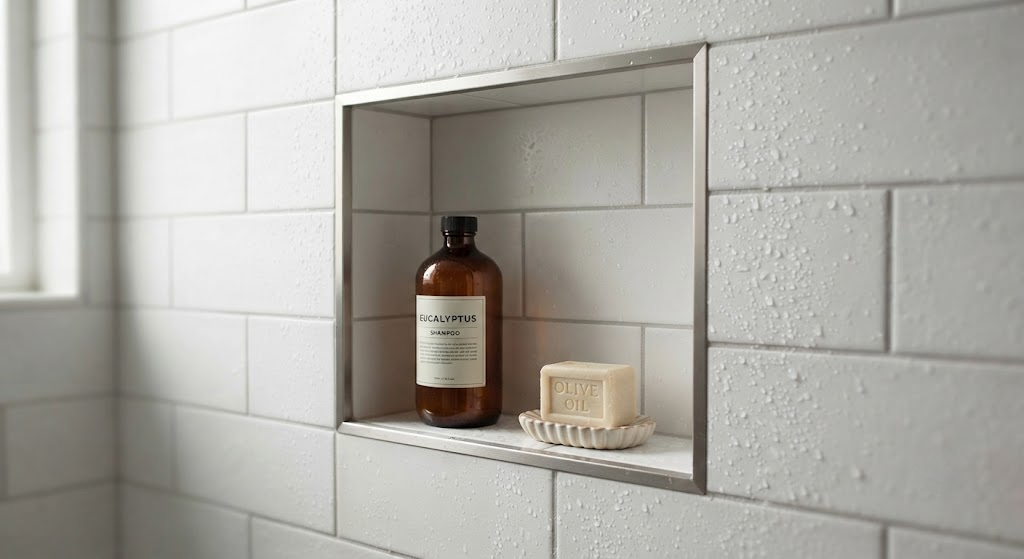
I have a drawer in my studio filled with the remnants of badly planned shower niches: a 12-inch bottle that never fit upright, a soap dish that perpetually filled with water, a niche framed so prominently it became the focal point of the entire bathroom. None of this is necessary.
A shower niche is not a decorative feature. It's a functional piece of millwork that happens to live in a wet wall. And most of them fail for three preventable reasons: they're too shallow, they're placed relative to the tile pattern instead of the shower spray, and they're built to hold products nobody actually owns.
How Deep a Niche Actually Needs to Be
Standard wall framing with a 2×4 stud cavity gives you 3.5 inches of depth. Subtract the backer board, waterproofing membrane, thinset, and tile, and you're left with a finished interior depth of roughly 3 inches. That fits a bar of soap. It does not fit a standard 3-inch-diameter shampoo bottle standing upright without the bottle leaning forward and sliding out.
The 4-Inch Minimum
I spec niches at a minimum finished interior depth of 4 inches. That means building the niche box as a separate pre-fabricated unit that projects slightly into the stud cavity — or furring out the entire shower wall to create a deeper cavity. In a 2×6 wall, you get 5.5 inches of cavity depth and can finish at 5 inches, which fits oversized bottles, a safety razor stand, and a small plant if you're the plant-in-the-shower type.
The depth number is not negotiable. Measure the tallest bottle in your household. Add a half inch for the bottle cap and another quarter inch so your hand can grab it from above. That's your minimum depth. Build to the bottle, not to the stud.
Where to Place It — and Where Not To
A niche should never sit directly in the spray line of the showerhead. Water hits the back wall, ricochets off your body, and floods the niche shelf. Every bar of soap becomes a puddle. Every shelf collects a thin film of standing water that dries into soap scum by morning.
The Keep-It-Dry Rule
Place the niche on the side wall perpendicular to the showerhead, or on the back wall but offset at least 12 inches from the showerhead centerline. The goal is to keep the niche in the warm, steamy zone but outside the direct spray cone. If you have a handheld showerhead on a slide bar, place the niche on the opposite wall entirely.
In a shower that's 60 inches wide, I'll often place a vertical niche stack on the side wall — two compartments, one at chest height for daily-use products and one at shin height for backup bottles and a razor tray. The lower niche gets less spray, so it stays drier longer.
The Tile-Layout Trick That Hides a Niche
A niche that interrupts the tile grid with a random opening reads as a hole in the wall. A niche that lands neatly within the grout lines disappears.
Align, Don't Interrupt
I size the niche opening to match full tile dimensions so the grout lines of the niche interior align exactly with the field tile on the surrounding wall. In a subway tile layout with 3×6 tiles and 1/8-inch grout lines, that means a niche that's 6 inches wide, 12 inches tall, and a depth that's a clean multiple of the tile thickness plus grout. The trim — Schluter or a mitered stone edge — falls exactly on the grout line.
This is the kind of detail that costs nothing extra. It requires the tile setter to know the niche dimensions before they lay out the wall — which means you spec the niche before the tile goes up, not after.
The niche should be the quietest thing in your shower. If it's what people notice first, something went wrong. If they don't notice it at all but reach for the shampoo without looking, it's perfect.