
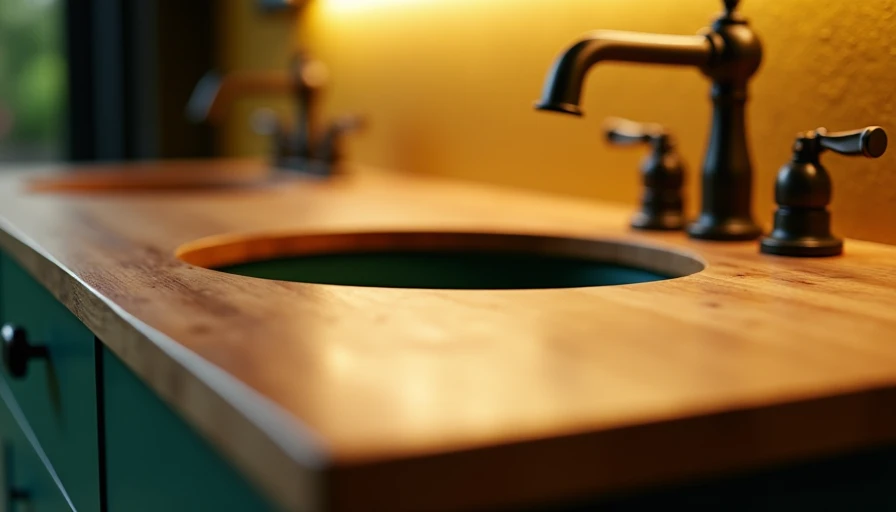
A wood bathroom countertop can make a compact bathroom feel warmer, calmer, and more considered than a standard white vanity top. In a 5-by-7 bathroom, that change matters: one large horizontal surface is often the first thing you see when you open the door. The goal is not to recreate a rustic farmhouse bathroom. It is to choose a material, edge, sink, and finish that earn their footprint while handling daily splashes.
I have used wood in bathrooms from narrow Silver Lake powder rooms to larger primary baths, and the successful examples all share one trait: the wood is treated as a design element, not an afterthought. You do not need a full renovation to get the effect. A replacement vanity top, a wall-mounted sink cabinet, or even a properly sealed shelf can shift the entire room.
Start with the right dimensions
Before choosing a species, measure the vanity cabinet, wall clearances, faucet position, and door swing. A standard bathroom vanity is commonly 18 to 24 inches deep, while a small powder-room cabinet can be closer to 16 inches. For a single sink, 24 to 30 inches wide is usually comfortable; going narrower can leave almost no usable landing space beside the basin.
For a wood bathroom countertop, I prefer a top that projects no more than 1 inch beyond the cabinet unless the overhang is intentional. In a tight room, an extra 2 inches can turn a clear walkway into an awkward squeeze. Keep at least 4 inches between the sink rim and the side wall when possible, and reserve roughly 3 inches behind the faucet for installation and cleaning.
A 1 1/4-inch-thick top creates a substantial, furniture-like profile. That thickness looks excellent on a floating vanity, but it can feel heavy on a 20-inch-wide cabinet. A 3/4-inch top with a clean eased edge is often the better proportion for a rental or budget refresh.
Pick a species that suits the room
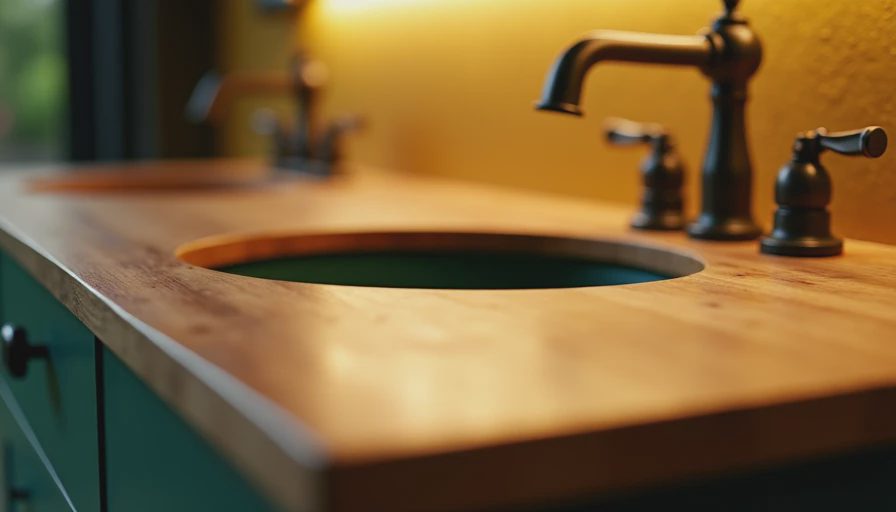
Oak, maple, walnut, and teak are practical starting points. White oak has a calm grain and works with white tile, terrazzo, or brushed nickel. Walnut brings depth to a room with pale walls, though its darker color shows water spots more readily. Maple is light and relatively quiet, making it useful when patterned tile already supplies visual interest.
Teak is naturally more moisture-resistant than many domestic woods, but it is not waterproof. It can work beautifully in a coastal or minimalist bathroom, especially with matte black fixtures, but its oily surface needs careful preparation before finishing. Bamboo can be a cost-conscious alternative with a clean linear grain. Look for a quality laminated panel rather than the cheapest furniture board, whose edges can swell after repeated exposure to water.
A wood bathroom countertop does not need to match the floor, shelves, or mirror frame exactly. In fact, matching every wood tone can make a small bathroom feel staged. Choose one dominant wood note and let the remaining finishes support it. A walnut top with oak accessories is usually more interesting than a room filled with nearly identical brown surfaces.
The finish determines whether it lasts
The most important construction detail is sealing every surface, including the underside, faucet hole, sink cutout, and exposed end grain. Water finds unfinished edges quickly. A top that looks sealed from above can still absorb moisture around the basin if the cutout was ignored.
For a wood bathroom countertop, a film-forming finish such as a marine-grade spar urethane or a bathroom-rated polyurethane offers strong water resistance. Apply multiple thin coats according to the product instructions and lightly sand between coats when directed. Waterlox is another commonly considered option for wood surfaces because it creates a durable moisture-resistant coating, while hardwax oils such as Rubio Monocoat create a more natural-feeling surface but demand disciplined maintenance.
Do not use a decorative stain as the only protection. Do not rely on mineral oil, either; it is appropriate for some kitchen cutting boards but requires frequent reapplication and is a poor standalone bathroom finish. Allow the coating to cure fully before installing the sink or placing toiletries. A rushed installation can trap moisture under hardware and create swelling before the vanity is even finished.
Choose the sink and faucet as a system
An undermount sink gives a wood bathroom countertop a cleaner silhouette because water can be pushed directly into the basin. It does require a carefully sealed cutout and professional-looking edge work. A vessel sink is easier to install in some cases and can preserve more counter area, but it raises the bowl several inches. In a bathroom used by children or anyone with limited reach, that extra height is not a small detail.
A 16-by-12-inch rectangular vessel can work on a 24-inch vanity, but leave enough room for soap and a hand towel. A compact undermount basin is often better in a narrow room because it keeps the visual line low. Wall-mounted faucets can free up counter space, although moving plumbing inside the wall is a larger project than swapping a standard deck-mounted faucet.
For a wood bathroom countertop, use a faucet with a broad enough base to cover the drilled opening and avoid placing the hole too close to the back edge. Confirm the faucet’s reach before cutting. A beautiful top with a short spout that misses the center of the basin is a daily irritation, not a minor installation flaw.
Make the material work with a small-space palette
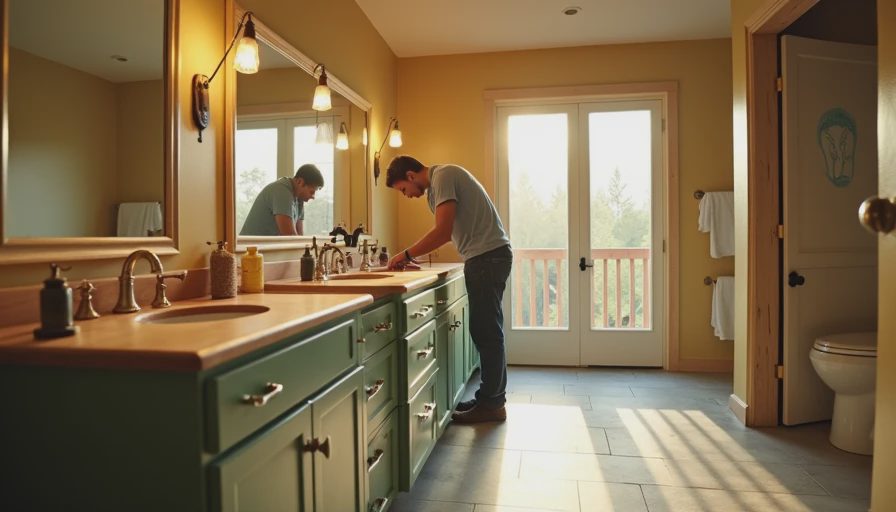
Wood looks best in a small bathroom when the surrounding palette gives it room to breathe. Pair a medium-toned top with warm white paint, pale gray grout, or a softly patterned ceramic tile. If the bathroom already has busy floor tile, choose a quieter grain and a simple rectangular sink. If the walls are plain, walnut or rift-sawn oak can provide the needed texture without adding artwork or open shelving.
Lighting changes the appearance dramatically. A 2700K to 3000K LED at the mirror generally makes wood feel warmer and more flattering than a very cool bulb. Put the light at face height on both sides of the mirror when possible; a single ceiling fixture creates shadows and makes the counter seem darker. In a 5-by-7 layout, a shallow medicine cabinet can provide storage without consuming the visual space that a deep mirrored cabinet would.
Keep the counter mostly clear. One soap dispenser, a small tumbler, and perhaps a low ceramic tray are enough. The more objects sitting beside the faucet, the more opportunities there are for standing water and visual clutter.
Budget, installation, and maintenance
A basic wood panel may cost around $100 to $250, while a custom hardwood top with sink cutouts and finished edges can reach $400 to $900 before installation. Refinishing an existing vanity top is often the least expensive route, especially if the cabinet is sound and the plumbing does not need to move. Installation, sink fitting, and plumbing can add several hundred dollars depending on access and local labor rates.
A simple care routine protects the investment. Wipe spills instead of letting them sit, dry the area around the faucet after heavy use, and use a tray beneath bottles that tend to leak. Inspect the finish every few months for dull patches, hairline cracks, or swelling at the sink edge. Touch up early; repairing a small damaged area is far easier than replacing a warped top.
If your budget is tight, spend first on accurate cutting and a complete seal. A less expensive oak top installed carefully will outperform expensive walnut with an unsealed sink opening. That is the design decision that matters most.
Final design recommendation
A wood bathroom countertop is a strong choice when you want character without adding bulk. For most small bathrooms, I would choose a 24-to-30-inch-wide white oak or walnut top, keep the depth near 18 to 21 inches, use an undermount sink, and finish the entire piece with a proven moisture-resistant coating. The result feels custom without requiring custom-everything money.
Skip the oversized rustic slab, the high vessel bowl on a shallow cabinet, and any finish described only as “water resistant” without clear application instructions. Measure twice, seal every edge, and design the countertop around how the room actually functions. In a small bathroom, restraint is not a compromise; it is what makes the material look expensive.