
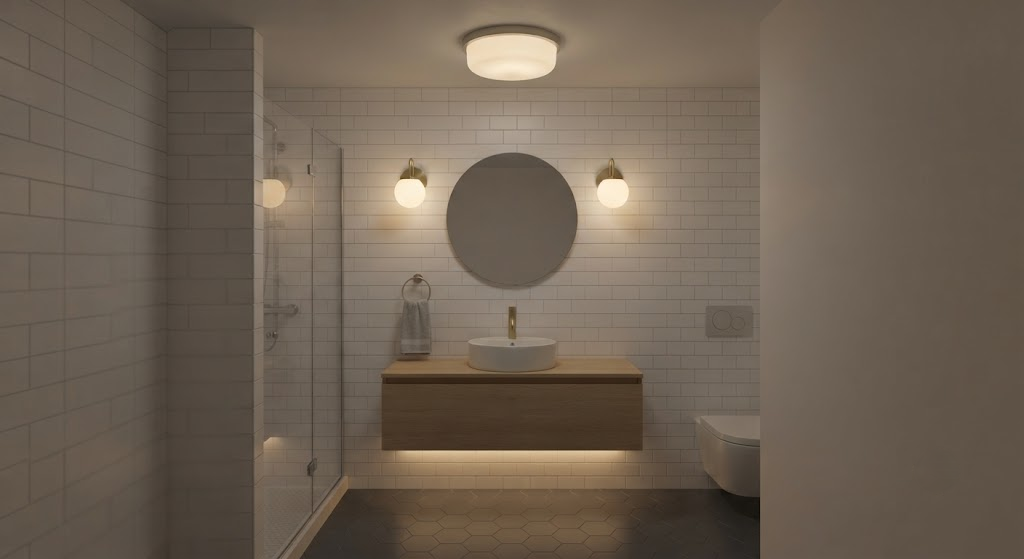
Most small bathrooms have one light source: a flush-mount ceiling fixture in the center of the room. It casts shadows downward, turns your face into a topography of under-eye hollows when you look in the mirror, and leaves the corners of the room in permanent dusk.
The fix is not more wattage. It's more layers. Every well-lit room — bathroom or otherwise — uses three layers of light: ambient, task, and accent. You can achieve two of those three in a rental bathroom without touching a wire. You can achieve all three in a weekend if you have access to the circuit.
Ambient Light: The Base Layer
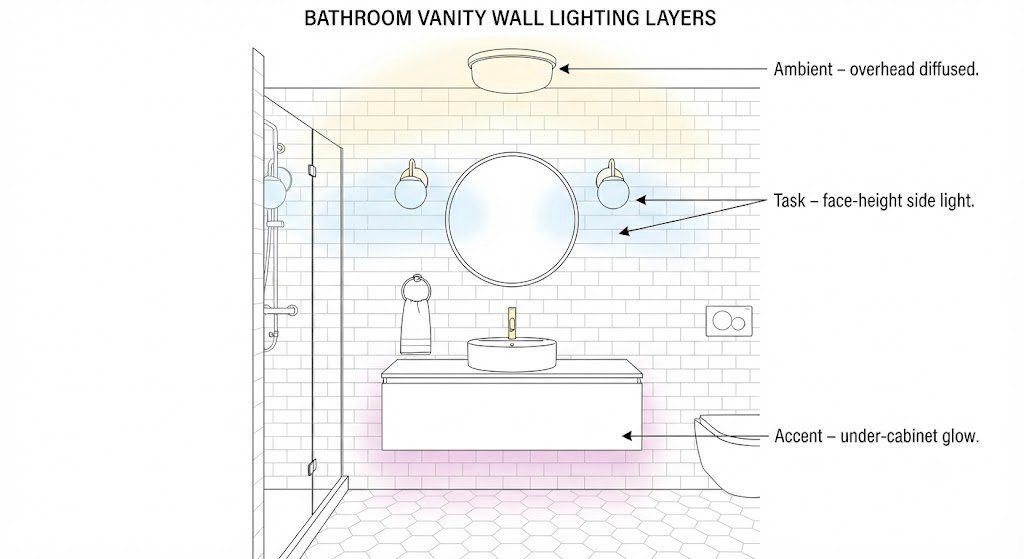
Ambient light is the room's general illumination — the light that fills the volume so you can walk in, see the floor, and not stub your toe on the toilet base. In most bathrooms, that's the ceiling fixture you already have.
If You Can't Replace It, Defuse It
A bare bulb or a dated glass dome throws hard light that bounces off tile and creates glare. Swap the bulb for a warm-dim LED with a color temperature of 2700K to 3000K. Add a clip-on fabric shade or a magnetic diffuser panel if the fixture allows. The goal is soft, omnidirectional light that fills the room without calling attention to the source.
In a rental, I've used a $12 adhesive rice-paper shade that attached directly to the existing glass dome with removable mounting tabs. It looked intentional. It left no residue. It transformed the quality of light in the room instantly.
Task Light: The Mirror Layer
Task light is what lets you see your face clearly at the mirror — for shaving, makeup, tweezing, or just recognizing yourself at 6 a.m. Ceiling lights fail at this because they cast shadows from above. You need light at face height, coming from the sides or the front.
Sconces Without an Electrician
Hardwired wall sconces at 60 to 66 inches from the floor, flanking the mirror, are the gold standard. But there are three zero-wire alternatives that work:
Plug-in sconces with cord covers. Run the cord along the wall to the nearest outlet, concealed inside a paintable plastic channel. Paint it to match the wall. It reads as intentional millwork, not a DIY afterthought.
Battery-operated LED sconces. These have come a long way. Look for units with a remote control and a color temperature of 3000K. They mount with screws or heavy-duty adhesive, and you recharge them every few weeks via USB. I've spec'd these in three rental bathrooms now. One client liked them so much she took them when she moved.
A full-width vanity light bar above the mirror. This is the least ideal option — it casts some shadows downward — but it's better than a single ceiling fixture. Mount it 75 to 80 inches from the floor. The fixture should span at least three-quarters the width of the mirror below.
Accent Light: The Mood Layer
Accent light is the layer that makes a bathroom feel finished instead of functional. It's the glow under the vanity, the strip inside the niche, the small warm light that makes the room feel like someone cares about it.
Three Accent Lights You Can Add Tomorrow
Under-vanity strip. A 12-inch LED strip light with an adhesive backing, plugged into an outlet near the vanity. Use a warm-white strip (2700K) and mount it to the underside of a floating vanity or the bottom rail of a cabinet. The light pools on the floor and doubles as a nightlight.
Toe-kick light. If your vanity sits on legs or a recessed base, tuck a small puck light underneath. Battery-operated versions with motion sensors turn on when you walk in and off after 60 seconds. They cost about $20.
Niche or shelf light. If you have a recessed niche or an open shelf, a single battery-operated LED strip tucked into the top edge washes the tile inside with soft light and turns your shampoo bottles into a still life. It's absurdly simple and costs under $30.
The Color Temperature That Ties It Together
Every light source in your bathroom should share the same color temperature. If the ceiling fixture is 3000K, the sconces and the accent strip should be 3000K. Mixed temperatures — a 2700K bulb next to a 4000K bulb — make a small room feel disjointed and clinical. Pick one number and commit.
For most bathrooms, 2700K to 3000K is the sweet spot. 2700K reads as warm and candlelit. 3000K reads as clean and neutral. Above 3500K, you enter kitchen-and-operating-room territory. Don't go there.
Start with the layer you already have — the ceiling fixture. Change the bulb. Then add one more layer. You'll notice the difference more than any towel swap or paint color change you've made all year.